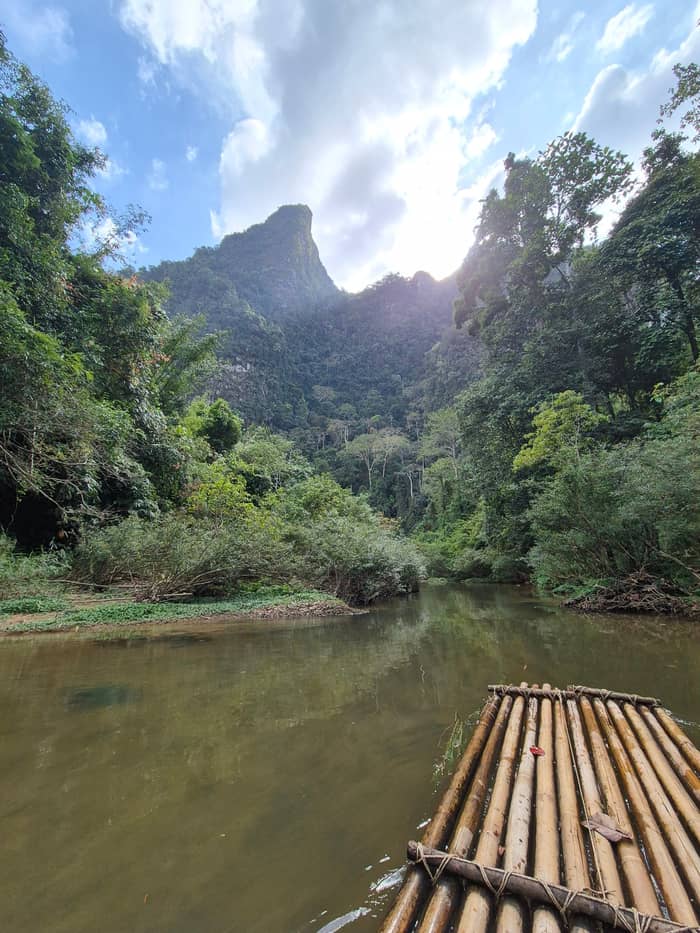
On foot
The forest
Trees and the small animals
Plan a visitYour group, priced
Compare 3 alternatives
Enter your party and compare three guided days that include trail time.
≈
View≈
View≈
ViewGetYourGuide's starting prices, converted at the ECB reference rate; exact pricing appears when you book.
The park in plain terms: what it protects, how big it is, which plants and animals the official lists name, how the lake came to be and what a visitor can realistically hope to see.
Editorial team, khaosokjunglehike.quest · Updated November 16, 2026 · Read in 9 min
Summary view
What is Khao Sok National Park? It sits in Surat Thani province in southern Thailand and guards one of the oldest evergreen rainforests in the country. TAT portrays it as a secret world tucked inside that ancient forest,6 and sums up the scenery as a rugged mountain range and a small plain, with limestone cliffs towering over a still reservoir.7 The sections below take the park apart piece by piece, from its size and its plants to its animals, its lake and its recent history.
On paper, the park is a terrestrial national park, gazetted on 22 December 1980 and classed as IUCN Protected Area Category 2.1 The ASEAN Centre for Biodiversity places it inside a network of forest ecosystems spanning 14 protected areas,8 which is a useful way to picture it: Khao Sok is one room in a very large house of forest that continues beyond the signposted trails. It is a protected landscape rather than a single viewpoint, which is why local knowledge counts for so much.
For a visitor, that means two things. The forest is real and continuous, so a day on a trail shows only a small part of it, and the lake is not a separate attraction but part of the same protected area. The same centre says the freshwater reservoir covers around 25% of the park, so boat trips on the lake happen inside the park boundary and not beside it.2 It also means the lake shapes the whole experience of the park for a day visitor.
What it is made of
| Habitat | Share of the park | What it holds |
|---|---|---|
| Moist evergreen forest | Around 65%2 | 86 tree species recorded3 |
| Freshwater reservoir | Around 25%2 | A fishery of about 300 tons a year13 |
| Limestone karst | Around 9%2 | 44 plant species recorded3 |
Shares as the ASEAN Centre for Biodiversity gives them; the shares do not add up to the whole, because other habitats are not listed there.2
TAT says the park was established in 1980 and covers 738.74 square kilometres, within Surat Thani province, in the Phanom and Ban Takhun areas.11 The ASEAN Centre for Biodiversity, on its own page for the park, gives an area of 660.65 square kilometres and a declaration as an ASEAN Heritage Park in 2021.12 The two figures do not match, and both come from respectable bodies. Neither page gives a reason for the gap, and we do not invent one.
There is no single correct answer to offer, and we would rather show the gap than pick a winner. Treat the size as an open question, and do not repeat one figure as if the other did not exist. The right habit is to cite each number with its owner, and to prefer the TAT figure for the gazetting and the ASEAN figure for the heritage listing.
What the two sources agree on is the order of magnitude: a large park, big enough that its limestone valleys, forest and lake can each fill a day. Quote the TAT figure if you want the one tied to the original establishment,11 and the ASEAN figure if you want the one tied to the heritage listing,12 and name the source either way. Be wary of any sign or brochure that gives a figure with no source at all.
The species count
Species recorded in the park, as the ASEAN Centre for Biodiversity counts them: 46, 95, 96, 118 and 296.3
The forest records are specific. The ASEAN Centre for Biodiversity lists 86 species of tree in the wet evergreen forest and 44 plant species on the limestone karst,3 and names endemic plants including Khaosokia caricoides, Impatiens sirindhorniae and Rafflesia kerri.18 Moist evergreen forest covers around 65% of the park, which makes it by far the largest habitat the centre lists.2
The Rafflesia is the park's celebrity. TAT counts it among the park's plants, and it is among the largest flowers in the world.17 In a TAT status list from 2023, a Rafflesia kerrii tourist site is marked shut between 1 May and 31 October,16 so the flower is something to ask about locally and not to assume, and seasons for it change from year to year. Ask a guide for the current situation rather than relying on a printed date, because a closure list is a snapshot.
Plant science here is not finished. The Department of National Parks announced on 2 January 2026 that a shrub, Coleus tomentifolius, thought extinct in the wild for more than 130 years, had been found again on limestone cliffs of Phang Nga and Surat Thani.10 The survey was done by boat along the cliffs at the Ratchaprapha Dam in Khao Sok and on into Ao Phang Nga National Park in 2024 and 2025.19
What now?
Tell us your interest and we match it to the part of the park that offers it.
If I want to see big animals
Manage your hopes
TAT says parks run no organised elephant watching.15
If I want gibbons and monkeys
A guided waterfall trek
The record names monkeys and gibbons as wildlife to look for.
If I want night animals
A night safari
It lasts 2.5 hours with hotel transfer.
If I want the lake and cliffs
A boat day
The reservoir covers around 25% of the park.2
If I want rare plants
Ask at the headquarters
The 2023 list shuts the Rafflesia site for the months from May to October.16
Habitats side by side
On foot
Trees and the small animals
Plan a visit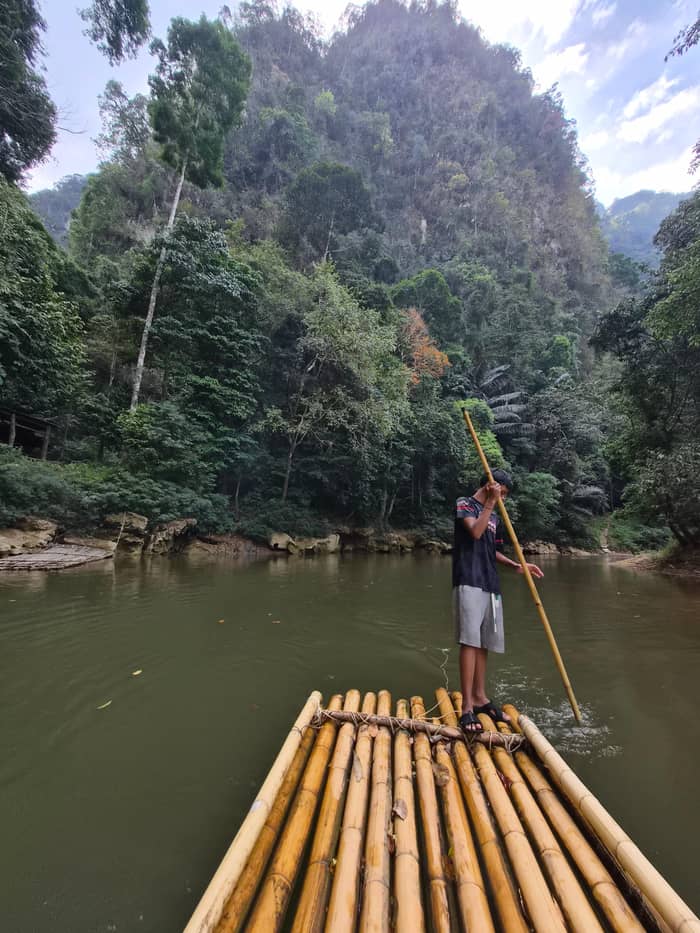
By boat
Karst and its plants
Plan a visit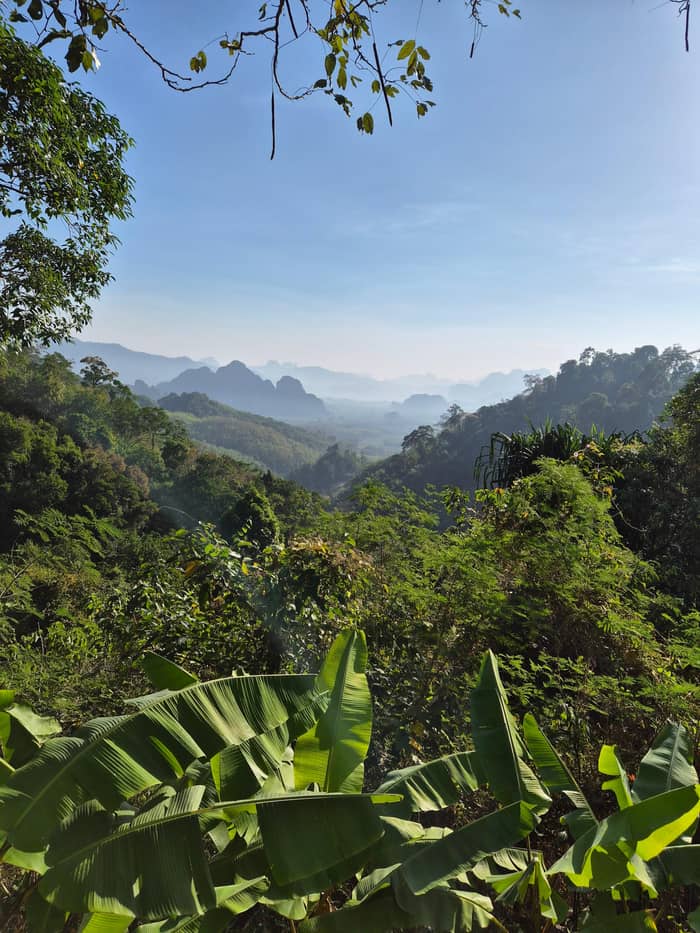
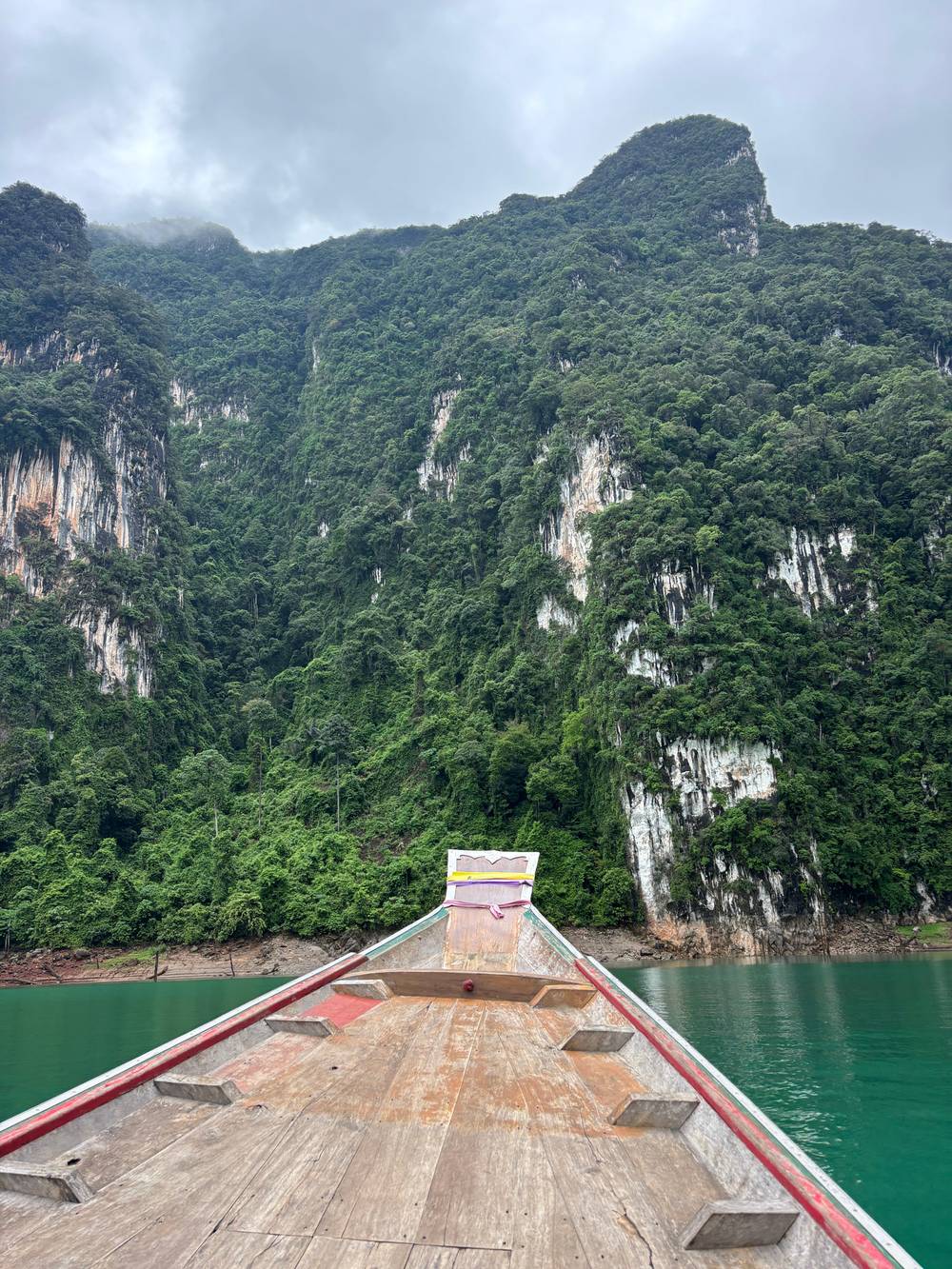
On water
A reservoir since the dam
Plan a visitThe recorded numbers are large. Surveys have logged 296 birds, 118 fish, 96 reptiles, 95 mammals and 46 amphibians.3 Of the whole list, the centre counts 40 rare species and 95 that appear on the IUCN Red List.23 Those are inventories of the whole protected area over time, and they do not tell you what a single day on a path will show. Use them as a measure of richness, then look at the day tours for what a visitor can actually see.
The mammals it names as endangered include the Asian elephant, the dhole, the lar gibbon and the Malayan tapir.24 For birds, it names critically endangered species including the helmeted hornbill, the blue-banded kingfisher and the grey-headed fish eagle.25 The Tourism Authority of Thailand adds the vulnerable mainland serow to its short list of the park's wildlife.26 A guide with a good ear finds more birds than a visitor with a camera, and that is the case for going with one.
On a day trip the animals within reach are the ones a guide can point out near the path. The half-day waterfall trek names monkeys, gibbons and insects as the wildlife to look for, and one night safari runs 2.5 hours for those who want nocturnal animals. Big mammals are another matter, and TAT is blunt: no park runs organised elephant watching.15 Whatever the birds and big mammals do, a walk with a guide who names plants and insects is a day well spent.
From forest to lake
At gazetting
The park was gazetted on 22 December 1980.1
Dam works begin
Construction of the dam began on 9 February 1982.4
Dam finished
The dam was completed in September 1987.4
Heritage listing
The park was declared an ASEAN Heritage Park, the 50th and the seventh in Thailand.9
Rediscovery
The Department of National Parks announced a shrub missing for more than 130 years.10
Does Khao Sok National Park have tigers? The official list does not name one. Among the critically endangered mammals, the ASEAN Centre for Biodiversity gives the Sunda pangolin and the leopard as examples, and a tiger is not among the examples it names.5 That is not the same as saying a tiger has never lived in the forest, and we do not claim it. It is simply what the official record shows. A tiger is a natural question for a forest park, so it deserves a straight reply with the facts behind it.
For a traveller, the practical answer is that a tiger is not part of any visit. Nothing in the park's own lists, the tourism authority's wording or the tour records promises one, and the guided walks sell the forest, the river and the small animals along them. If someone at a guesthouse tells you a tiger sighting is likely, treat it as a story and not as information. So the honest summary for the title question is a forest park with rare animals and a lake, not a safari park with a fixed cast.
If large animals interest you, the safer way to think about the park is as habitat. Elephants, gibbons, tapirs and hornbills share a forest that the official lists describe in terms of habitat and species, and none of them is a roadside attraction. A guide who knows the area is worth more than any other single choice you can make. None of this makes the walk less worthwhile; it simply sets the right expectations before you pay for any outing.
Video
CNA on YouTube · Tap play to load the video; not before.
It is home to countless flora and fauna, including the mainland serow, Malayan tapir, and the Rafflesia
Seeing wildlife well
The Khao Sok National Park history that most visitors meet first is the lake, and the lake is a reservoir. The Electricity Generating Authority of Thailand began the dam, formerly called Cheow Lan Dam and now Rajjaprabha Dam, on 9 February 1982 and completed it in September 1987.4 It is a rockfill dam with a clay core, 94 m high, with a power plant contracted at 240 MW.27,28 Those are the engineering facts behind a valley that now reads as a quiet lake with cliffs and floating huts.
The lake had human costs. EGAT says it gave fair compensation and new land to 385 households affected by the reservoir.29 It also says water stored in the reservoir during the rainy season helps lessen flooding downstream, and that it stocks the reservoir with fish and prawns for a fishery of about 300 tons a year.30,13 A scenic lake and a working power station are the same object, seen from two sides. That context helps when you read a brochure that calls the lake purely natural.
EGAT even gives the reservoir a nickname, the Guilin of Thailand,31 and counts tourist arrivals at the dam and reservoir at over 150,000 a year.14 The raft houses and the long-tail boats on the lake belong to that tourism economy, and EGAT runs a clean-reservoir project that includes the national park and the operators of accommodation rafts and tourism boats.32 That tourism economy is part of why the lake feels so organised when you arrive, with piers, boats and floating accommodation all in place.
The park's profile has grown in step with the lake. The ASEAN Centre for Biodiversity records its declaration as an ASEAN Heritage Park in 2021,12 and TAT calls it the 50th such park and the seventh in Thailand.9 Heritage status is a recognition, not a visitor attraction, and it explains why the park turns up in tourism campaigns. It does not change what you can do on arrival. The label recognises the ecosystems of the whole park, not only the trails that visitors use.
The centre adds that tourism is managed to build awareness and offer ecotourism, with the geology reached by kayak, in Nam Lod Cave and on nature trails.33 In a feature on southern routes, TAT pairs rainforest scenery in the park with another day by long-tail boat among the limestone cliffs of the lake.34,35 For the day visitor, those lines point to a park built for walking, boats and caves, and not for driving through.
Put together, the history is simple to tell. A rainforest park was gazetted in 1980,1 a dam finished in 1987 turned its valleys into a lake,4 and a heritage listing in 2021 put it back in front of the world.12 Each step added a reason to visit, and each added a reason to visit with care, on marked trails and with a guide who knows the water. That is a fair summary for anyone deciding how much time to give the park, and the best-time page picks up from there.
FAQ
Gazetting came on 22 December 1980, and the IUCN class is Protected Area Category 2.1
Building began on 9 February 1982 and finished in September 1987.4
The centre's examples of critically endangered mammals are the pangolin and the leopard.5
TAT counts the Rafflesia among the plants of the park.17
The centre names the helmeted hornbill, the blue-banded kingfisher and the grey-headed fish eagle as critically endangered.25
Sources
Heading to Khao Sok? Ask a real person here.